portland selfdefense
Portland Academy of Self Defense: Building Organic Search Visibility and AI Discoverability in 90 Days

The Challenge: An Established Website That Needed Greater Visibility
Portland Academy of Self Defense had already invested considerably in its website. Built using custom PHP development, the website reflected the client’s vision and provided information about the academy’s Hapkido, martial arts, and self-defense programs.
The website was designed to help prospective students understand the available programs, explore the academy, and make enquiries. However, having a well-developed website did not automatically translate into the organic visibility and website traffic the business wanted.
The challenge was clear: How could we help an existing digital asset reach more of the people searching for martial arts and self-defense training in Portland and Beaverton?
Rebuilding the website was not the starting point. The priority was to build on its existing foundation through a structured organic growth strategy that combined traditional search optimization with emerging AI-powered discovery.
The Strategy: Traditional Search Meets AI Visibility
Digital Munk developed a focused three-month action plan around two complementary opportunities: improving the website’s visibility in traditional search results and beginning to build its presence in AI-powered discovery experiences.
1. Organic Search Optimization
The first priority was to strengthen the website’s ability to appear for relevant searches related to martial arts, Hapkido, and self-defense training in the local market.
The strategy focused on building discoverability around the services and audiences that matter to the academy, helping prospective students find relevant information when researching training options.
2. Answer Engine Optimization (AEO)
People increasingly seek direct answers when researching local services. AEO focuses on making website content clear, relevant, and useful for questions prospective customers may ask.
For a martial arts academy, this can include questions about self-defense training, age-specific classes, Hapkido, and how to get started.
The objective was to support clearer answers and stronger content relevance, rather than relying solely on conventional keyword targeting.
3. Generative Engine Optimization (GEO)
GEO focuses on improving how a business and its content can be understood, retrieved, and potentially referenced by generative AI experiences.
Digital Munk included AI visibility initiatives alongside traditional organic search work, while monitoring the available Generative AI reporting to establish an initial view of performance.
AEO and GEO complemented the broader strategy: making the academy easier to discover, understand, and evaluate across evolving search experiences.
4. Measurement-Led Execution
The campaign used Google Search Console and Google Analytics to monitor search visibility, clicks, website activity, and engagement.
This gave Digital Munk a practical basis for reviewing the first quarter and identifying priorities for continued optimization.
The First 90 Days: From Strategy to Measurable Results
The initial quarter was designed to establish the foundation for sustained organic growth. Digital Munk executed the agreed roadmap and monitored the available performance indicators across traditional search, AI visibility, and website activity.
The first-quarter results were encouraging, with measurable search exposure, website visits, and early visibility in Google’s Generative AI reporting.
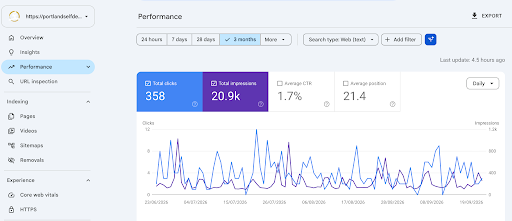
Google Search Performance
20,900 search impressions
The website appeared in Google search results approximately 20,900 times during the displayed three-month reporting period.
AI Search Visibility
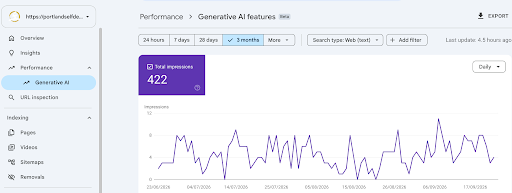
422 Generative AI impressions
Google Search Console’s Generative AI features report recorded 422 impressions during the displayed three-month period.
This was an early indicator of visibility in the AI reporting available to the campaign. It also established a metric that could be monitored as AI-powered discovery continues to evolve.
These impressions represent a reporting metric, not 422 website visits or confirmed AI-generated recommendations.
Website Traffic and Engagement
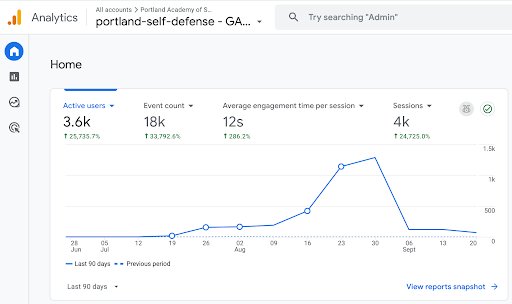
Google Analytics reported the following activity for its displayed last-90-days view:
- 3.6K active users
- 4K sessions
- 18K events
- 12 seconds average engagement time per session
These metrics provided an additional view of website activity beyond search impressions and clicks. The figures cover overall website activity and are not presented as organic-only results.
Taken together, the reporting established an initial picture of how people were discovering and interacting with the website, creating a foundation for more focused performance analysis in the next quarter.
What the First Quarter Established
The first three months delivered more than a reporting baseline. They provided encouraging early results and a clearer direction for continued work.
Greater measurable search exposure
The website recorded 20.9K search impressions and 358 clicks during the displayed period.
An initial AI visibility signal
The Generative AI report recorded 422 impressions, adding another measurement point to the strategy.
A clearer picture of website activity
Analytics recorded 3.6K active users and 4K sessions, alongside engagement and event data.
A foundation for the next phase
The results provided data to review, opportunities to investigate, and a basis for refining the next quarter’s priorities.
The focus was not to declare the work finished after 90 days. It was to establish a structured process for improving discoverability, measuring progress, and making informed decisions about continued growth.
The Next Quarter: Building on the Momentum
Organic growth is an ongoing process. The first quarter focused on establishing the foundation, executing the strategy, and evaluating the initial results. With that phase completed, Digital Munk and Portland Academy of Self Defense planned the next quarter.
The next phase builds on the initial work, with continued attention to relevant search visibility, AI discoverability, and the quality of website engagement.
The priorities are to evaluate which searches and pages offer the strongest opportunities, identify ways to improve the relationship between search exposure and website visits, and assess how website activity connects to enquiries and prospective student interest.
As more data becomes available, the strategy can be refined around the opportunities that matter most to the business.
Our approach is simple: plan by quarter, execute consistently, measure the results, and use the findings to shape the next phase.
The Takeaway: Your Website Is an Investment. Make It Discoverable.
Portland Academy of Self Defense already had a website that reflected its vision. The opportunity was to help that investment work harder by improving its discoverability through traditional search and emerging AI-powered experiences.
The initial three-month engagement delivered encouraging early results across search visibility, website activity, and AI reporting. It also created a practical foundation for the next quarter of growth.
At Digital Munk, we bring together organic search strategy, Answer Engine Optimization, and Generative Engine Optimization to help businesses strengthen their digital presence as the ways people discover services continue to change.
Have a website that isn’t reaching its potential? Let’s build a strategy around it.